
Rooftop solar and a twice-a-day battery for a Bellville logistics warehouse
Chepstow Properties (Pty) Ltd. · Bellville, Cape Town · Completed June 2026
Impact
- Of peak-hour energy covered by the battery
- 86.7%
- Morning and evening peak windows, year 1
- Payback period
- 39 months
- Including the Section 12B tax benefit
- Grid bill reduction
- 41.3%
- Year 1, against the site's municipal bills
- Of the site's energy supplied by solar
- 50.4%
- Share of annual consumption, year 1
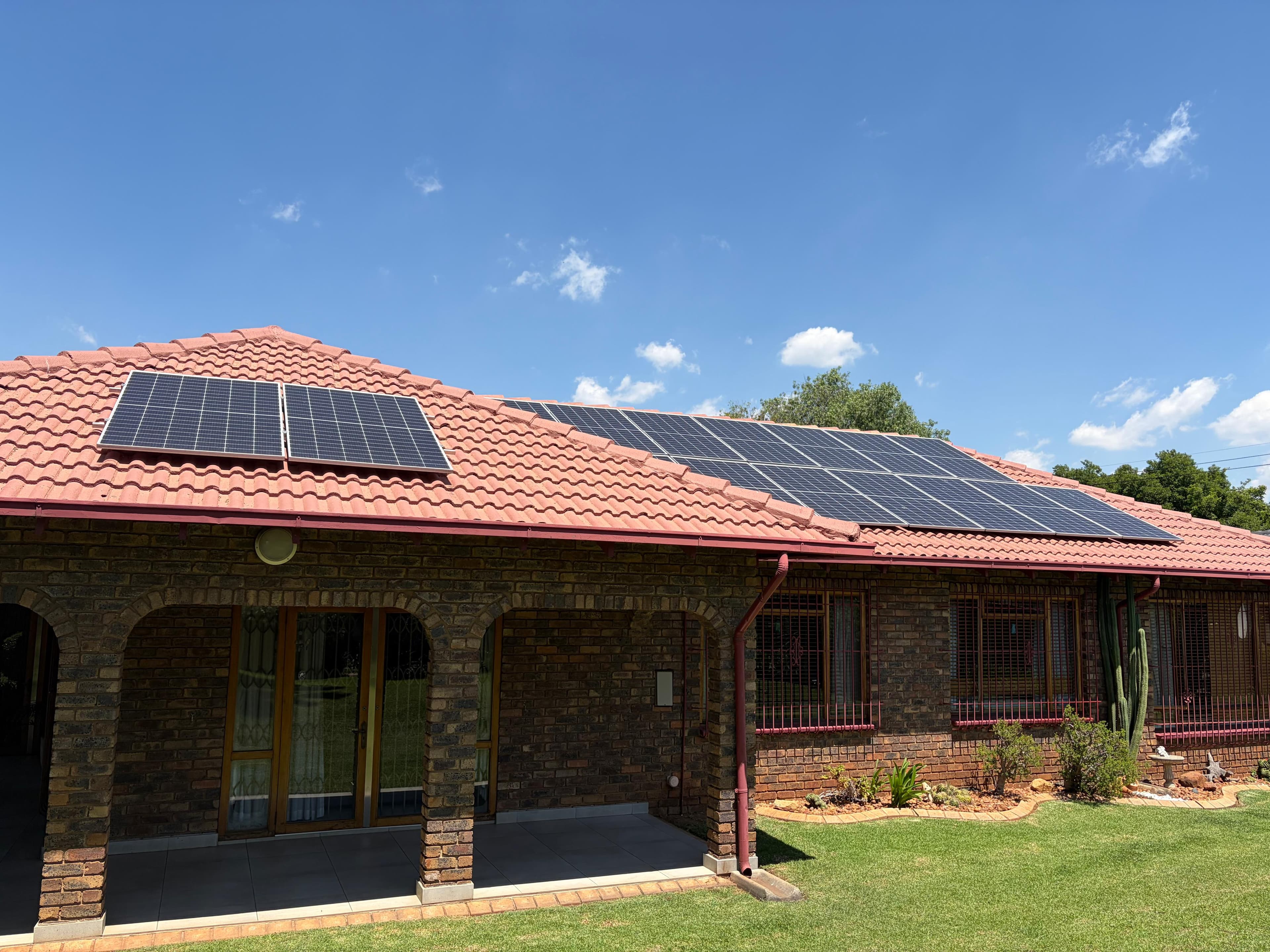
The site in photos
A logistics warehouse in Bellville now runs on an 82.8 kWp rooftop solar array and an 80 kWh battery that cycles twice a day. The site's busiest hours sat inside both of Cape Town's daily peak windows, so we sized the battery around those windows first and let the array follow. The owner bought the system outright.
Project facts
- Client
- Chepstow Properties (Pty) Ltd.
- Location
- Bellville, Cape Town
- Solar PV Capacity
- 82.8 kWp
- Battery Energy Storage Capacity
- 80 kWh
- Financing
- Outright Purchase
All project facts
Project
- Site
- Logistics warehouse
- Service
- C&I Solar & Storage
- Status
- Completed June 2026
Equipment
- Solar panels
- Astronergy 575 W bifacial module, 144 units
- Inverter
- WEG SIW500H ST030 M3, 30 kW three-phase hybrid, 3 units
- Battery
- WEG SBW200 CB100 W00, 10 kWh LiFePO4 module, 8 units
The challenge
Two peak windows, both inside working hours
The warehouse is billed on the City of Cape Town’s Large User time-of-use tariff. Energy is most expensive in two windows, early morning and late afternoon, and both fall inside the site’s working hours. At the rates in our model, peak energy cost about 2.4 times the off-peak rate.
The site uses roughly 12,900 kWh a month, with a maximum demand of about 84 kVA, and all of it came from the grid. With nothing to shift load, every tariff increase landed hardest on the hours the tenant needed power most.
For the owner, that is a property cost as much as a tenant cost. A warehouse that is expensive to run is harder to keep let.
Our solution
One battery, charged twice, working both peaks
We sized the battery before the array. The question was how much energy the two peak windows actually need, and in the model an 80 kWh battery covers about 87% of it.
The battery runs two cycles a day. Overnight it charges from the grid at the off-peak rate and carries the site through the morning peak. Around midday the array makes more than the warehouse uses, and that surplus recharges the battery in time for the evening peak. Cycling twice lets a smaller battery cover both peaks, which keeps the capital cost down.
On the roof are 144 Astronergy 575 W bifacial modules, 82.8 kWp in total, feeding three WEG 30 kW three-phase hybrid inverters. Eight WEG 10 kWh battery modules make up the 80 kWh of storage.
The outcome
Commissioned in June 2026, with a 39-month payback projected
The system was commissioned on 11 June 2026.
Our final design model projects that solar will supply about 55% of the site’s energy and that the battery will cover about 87% of peak-hour energy. The grid bill is projected to fall by about 41% in the first year, and with the Section 12B tax benefit the system pays for itself in about 39 months.
The savings should grow over time. Municipal tariffs go up every year, while most of the system’s cost was paid on the day it was bought. For the tenant that means lower running costs. For the owner it means a warehouse that is cheaper to operate and easier to keep let.
Project facts
Project
- Site
- Logistics warehouse
- Client
- Chepstow Properties (Pty) Ltd.
- Location
- Bellville, Cape Town
- Service
- C&I Solar & Storage
- Status
- Completed June 2026
- Financing
- Outright Purchase
System
- Solar PV Capacity
- 82.8 kWp
- Battery Energy Storage Capacity
- 80 kWh
Equipment
- Solar panels
- Astronergy 575 W bifacial module, 144 units
- Inverter
- WEG SIW500H ST030 M3, 30 kW three-phase hybrid, 3 units
- Battery
- WEG SBW200 CB100 W00, 10 kWh LiFePO4 module, 8 units
Similar projects
Hybrid Solar and Storage in Brakpan
Brakpan, Gauteng
- Grid independence
- 80%
- Uptime
- 100%
7.4 kWp · 20 kWh

St Andrews Office Park - Block A
Germiston · St Andrews Block A Body Corporate
- Lower municipal bill
- 41%
- Of the park's energy supplied by the system
- 77%
67 kWp · 80 kWh
Start your project